Post #3 - His Argument - 3/18
For this post, I've decided to write about the overall meaning, or argument, of Bryan Stevenson's book, Just Mercy. While all of our books that we are reading have to do something with race, whether it be about the historical side or even the modern side of it, Stevenson bases his entire book off of the legal side of it. Him being a lawyer gives him a high level of credibility when it comes to the judicial and law enforcement aspects surrounding race. Throughout his book, he talks about and shows examples of the injustices that African Americans must endure both on the streets and in the courtroom. I feel that it is beyond safe to say that Stevenson's argument is that our legal system is, most specifically in the '70s, '80s, and '90s, built to give black Americans an extreme disadvantage in any situation involved with the law.
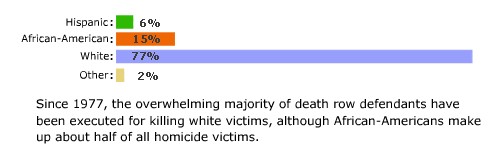
(Disclaimer: I would like to point out the all of my information being presented is from between the years 1970 and 1990 and in no way is what's happening currently. The amount of states still allowing or even using the death penalty has dramatically decreased in recent decades. I am only writing about the arguments and evidence presented from the time period the book's stories take place.)
The biggest thing that Stevenson had consistently pointed out throughout the book is that how not only does the race of the crime committed affect the outcome of the trial, but also the race of the victim. He found that if it was a crime where a white person harmed or even killed a black person, the punishment was far less than if the roles were reversed. He wrote,
"...the race of the victim is the greatest predictor of who gets the death penalty in the United States. The study conducted for that case revealed that offenders in Georgia were eleven times more likely to get the death penalty if the victim was white than if the victim was black. These findings were replicated in every other state where studies about race and the death penalty took place. In Alabama, even though 65 percent of all homicide victims were black, nearly 80 percent of the people on death row were there for crimes against victims who were white. Black defendant and white victim pairings increased the likelihood of a death sentence even more." (pg 142)
These numbers are just astonishing, and not even close to in a good way. This shows that not only did the judicial system act harsher on blacks, but they even sentenced people to death just to "appease" the white victims' community. Steveson specialized in getting black folks off death row and while many of them were guilty, some of them didn't even know about the crime they were accused of until they were being arrested for it. An example of this being Walter McMillan who was sentenced to exacting for the murder of a young, popular white girl. His conviction was solely based upon a made-up story from a white man and supposed witness. While there was no evidence against him whatsoever other than an elaborate clearly false testimony, Walter was still sentenced to death. The local police department had failed to provide the white community with an arrest for months, and when there was even a slight thought of Walter being a suspect, they pounced on it right away. The faster that Walter was both black and male made it so they could easily convince the racially biased community, judge, and jury of his "guilt". While I have not read far enough into the book yet to tell you whether or not Walter is later taken off death row, it is still disgusting that this ever even happened.
Chart showing how the race of the victim affects the outcome of the trial.
It is quite clear the argument Brayn Stevenson is trying to get across is that the judicial system was stacked against black Americans, and was used as a way to satisfy white Americans. He not only expresses this opinion very clearly, but uses information, data, and examples that make it so no logically thinking human can disagree with him. I personally feel that if he stopped his book right now, it would still be successful in proving his points, so I am very excited to see what the second half of the book has to offer.
Work Cited:
Stevenson, Bryan. Just Mercy: A Story of Justice and Redemption. 2019 ed., New York, Spiegel & Grau, 2019.
"Death Penalty and Race." Amnesty International, 18 Mar. 2017, www.amnestyusa.org/issues/death-
penalty/death-penalty-facts/death-penalty-and-race/. Accessed 18 Mar. 2021.


The graph you've included is helpful to show the point you, and Stevenson, have made. What do you think is the most effective way that Stevenson has made his argument?
ReplyDeleteI feel that the most effective way he has made his argument is that he's used different facts constantly throughout the book. I've said in previous posts that his kept his emotions out of the book making it much more effective and so far he's kept up with that. He forces you to come to the conclusion on your own without actually directly making you. This is a true sign of a skilled writer in my opinion.
Delete