Post #4 - Relevance - 3/25
In this week's blog, I am going to focus on the relevance that different parts of Bryan Stevenson's still have today. However, this book being only 6 years old makes it so that it's already both about and related to most of today's topics. I'm going to focus on two main passages from my book and talk about how they are still prominent topics and issues today.
There are countless instances throughout Stevenson's book where he talks about an issue or event that can be directly correlated to events happening right now in America and around the globe. While I only covered two passages out of the entire book, I still find it startling how many parallels can be drawn between 1980's America and today.
Farr, Tress. "'All Lives Matter': The Issue with This Response to the #BLM Movement." The Looking
The first passage I am going to cover is an interaction that Stevenson had with an Alabama judge during a court case where the jury was unfairly chosen. Stevenson was arguing that it was unfair that not a single black juror was picked and that it was unfair to the defendant because juries were already considerably racially biased. The judge did in fact grant Stevenson's motion, but not without saying something extremely foolish first. He said,
"I'm going to grant your motion, Mr. Stevenson, but I'll be honest. I'm pretty fed up with people always talking about minority rights. African Americans, Mexican Americans, Asian Americans, Native Americans... When is someone going to come to my courtroom and protect the rights of Confederate Americans?" (pg 193)
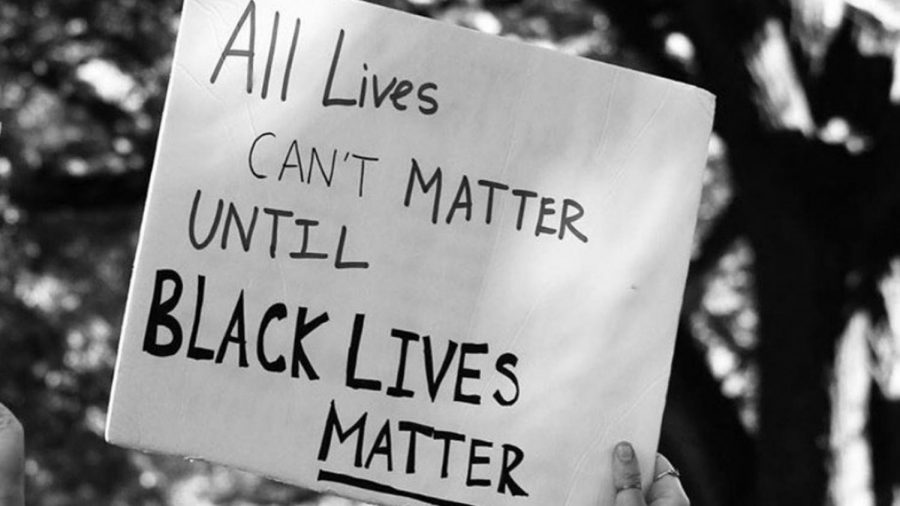
I mean, it's not even a question whether or not this was an acceptable thing to say, especially not as a prominent public figure such as a judge. While this was a considerably common opinion in the deep during the given time period, it still can sadly be seen today. We all know about the events surrounding race that happened in 2020, and there are thousands of things you could connect to it from the racism talked about in this book, however, this passage relates to a highly controversial topic that came up in the past year. That being the topic of "all lives matter". At the beginning of the black lives matter protests, there can be many instances where you see celebrities or just regular people posting out the words "all lives matter". At first glance, yes, this is a good thing. I mean who can argue that all lives don't matter. However, this slogan quickly became viewed as being "tone deaf" and missing the point. The whole reason behind the black lives matter movement is to protect those minorities that are being unfairly treated on all levels of our society. By saying "all lives matter" you're essentially saying that things are equal among races and that everyone faces the same challenges. This is exactly what this judge is saying, only in different words. By him saying that the rights of "Confederate Americans" need to be protected, he's really just dismissing the fact that all of the other minorities have actual problems. It is important to see the connection between what this judge said and "all lives matter" because it shows us how ignorant we sound when we say it. There's no question that what the judge said to Stevenson is wrong, so why are we question whether if saying "all lives matter" is wrong or not?
Sign used during black lives matter protests in 2020 (Farr)
The next passage that I chose to connect to the present day doesn't actually have anything to do with race, but still has to do with a poorly treated minority group. The group talked about in this passage is the mentally ill, and I feel that this is also a very important topic that Stevenson covers in-depth in his book. During his career as a lawyer, Stevenson focused on getting wrongfully of unfairly convicted blacks off of death row. Most often these people were given no chance at all by the courts solely because of the color of their skin. However, Stevenson also dedicated a good portion of his career to helping get mentally ill convicts off of death row and into care facilities. The most common reason mentally ill individuals find themselves on death row is because the court refused to believe that they had any serious mental issues. The person could even be visibly distressed, but the court would still sentence them to death instead of giving them the help they needed. Stevenson wrote,
"There are hundreds of ways we accommodate physical disabilities- or at least understand them. We get angry when people fail to recognize the need for thoughtful and compassionate assistance when it comes to the physically disabled, but because mental disabilities aren't visible in the same way, we tend to be dismissive of the needs of the disabled and quick judge their deficits and failures. Brutally murdering someone would, of course, require the State to hold that person accountable and to protect the public. But to completely disregard a person's disability would be unfair in evaluating what degree of culpability to assign and what sentence to impose." (pg 199)
It's saddening to see this happen. Mental health is an EXTREMELY big part of society today and while our recognition and solutions to it have improved, we are still not where we need to be. Courtrooms in America have become much better about dealing with mentally challenged convicts and most often get them the help they need. But, sadly, these people are getting this help after the crime, whether it big or small, has already been committed. The National Center for Biotechnology Infomation has concluded that over 60% of all mass shootings in the past 50 years have been done by confirmed mentally ill individuals(Metzl). To make this even worse, it wasn't until about a decade ago we became constantly able to identify mental illnesses, meaning that in those 40 other years, the percentage of shooters being mentally ill is even higher than recorded. This is a terrifying problem that much like racism needs to be solved for America to get any better.
Farr, Tress. "'All Lives Matter': The Issue with This Response to the #BLM Movement." The Looking
Glass, Montrose School, 10 June 2020, lookingglass.montroseschool.org/opinions/2020/06/10/all-
lives-matter-the-issue-with-this-response-to-the-blm-movement/. Accessed 25 Mar. 2021.
Metzl, Johnathan. "Mental Illness, Mass Shootings, and the Politics of American Firearms." PMC,
Metzl, Johnathan. "Mental Illness, Mass Shootings, and the Politics of American Firearms." PMC,
NCBI, Feb. 2015, www.ncbi.nlm.nih.gov/pmc/articles/PMC4318286/. Accessed 25 Mar. 2021.
Stevenson, Bryan. Just Mercy: A Story of Justice and Redemption. 2019 ed., New York, Spiegel &
Grau, 2019.


Picking out two passages to relate to current events was a smart approach. Do you think that there is as much focus on the police knowing how to handle a mentally ill person as there needs to be? How does that relate to some of the issues of police violence that are occurring?
ReplyDeleteHi Brendan!
ReplyDeleteI liked how you picked two specific paragraphs to talk about for your current events. I also thought it was interesting how you connected Stevenson's interaction with Alabama judge to the topic of "all lives matter." I hadn't made this connection when I was reading the book but I completely agree with what you said about it. It seems crazy that people could think that what the judge said was wrong, yet saying "all lives matter" isn't, even though they are implying the same thing. I also really liked how you talked about the issues with mental illness, especially among criminals. I think that many people don't understand the full effect that mental illness can have on our brains and how we act. While mental illness is a big contributing factor to many crimes, what other factors do you think come into play, causing people to commit crimes?
Kally,
DeleteOne other factor that Bryan Stevenson brought up a lot was poverty. If someone comes from a poor family and/or lives in a poor community they are much more likely to commit crimes. While this doesn't automatically makes poor people criminals, it just increases the likelihood of them at some point or another ending up in jail. Another reason this is true is because if they are brought to court, they can't afford the legal assistance needed to be given a fair sentence.